2005
SPECTO was introduced, enabling emergency luminaires to perform routine self-testing in compliance with EN62034.


Specto-XT delivers advanced emergency lighting control with wireless transceiver technology enabling real-time monitoring, effortless management, and full compliance. It exceeds all current regulatory testing and compliance reporting requirements. Luminaires automatically communicate test results and system health to the Specto-XT Gateway, which uploads data directly to a secure web portal no extra cabling, no hassle.
Best of all, ongoing use of the portal and remote testing is completely free when you choose Specto-XT versions of Philip Payne products. No subscriptions. No hidden costs.
Operating on a robust 868MHz frequency, Specto-XT avoids interference and ensures quick, reliable setup via an advanced mesh network. It supports up to 250 luminaires per Gateway and works across the full Philip Payne range offering unmatched flexibility.
Whether updating configurations or expanding your system, Specto-XT delivers seamless control, without compromise.

Uses a wireless mesh radio network to ensure data signals find the most effective communication path.

Operates at 868MHz for superior transmission distances and enhanced signal penetration.
Transmits data less than 1% of the time, keeping wireless activity minimal for optimal efficiency.

Utilises wait-before-transmit logic to ensure reliable, error-free data transmission.

Luminaires only need a mains connection, removing the need for data cables, extra power supplies or control modules.

Quickly and easily commission all luminaire types with a single, robust handheld infrared programmer.

Manufactured at our factory in Solihull, UK.

The Specto-XT Gateway and Gateway Lite send instructions for tasks like automatic testing schedules, transmitting data to the web for easy access on any device.
Philip Payne has a proud history of simplifying compliance with emergency standards, evolving our systems alongside technological advancements.
SPECTO was introduced, enabling emergency luminaires to perform routine self-testing in compliance with EN62034.
SPECTOLINK allowed self-testing emergency products to connect across multiple floors and report faults to a central location, like a facility management office, without manual intervention.
SPECTOWEB enabled groups of up to 64 luminaires using the DALI protocol to communicate with a central controller, which could then upload results to a web server.
SPECTO-XT, using a wireless mesh and a simple gateway, eliminates the need for wiring and central control devices, free from DALI grouping constraints.
SPECTO-XT is enhanced with a new, faster, wireless network and full IoT permanent connectivity. Users can now interact with devices from anywhere, allowing remote diagnostics and testing as well as remote support, working ‘live’ with engineers in the field.
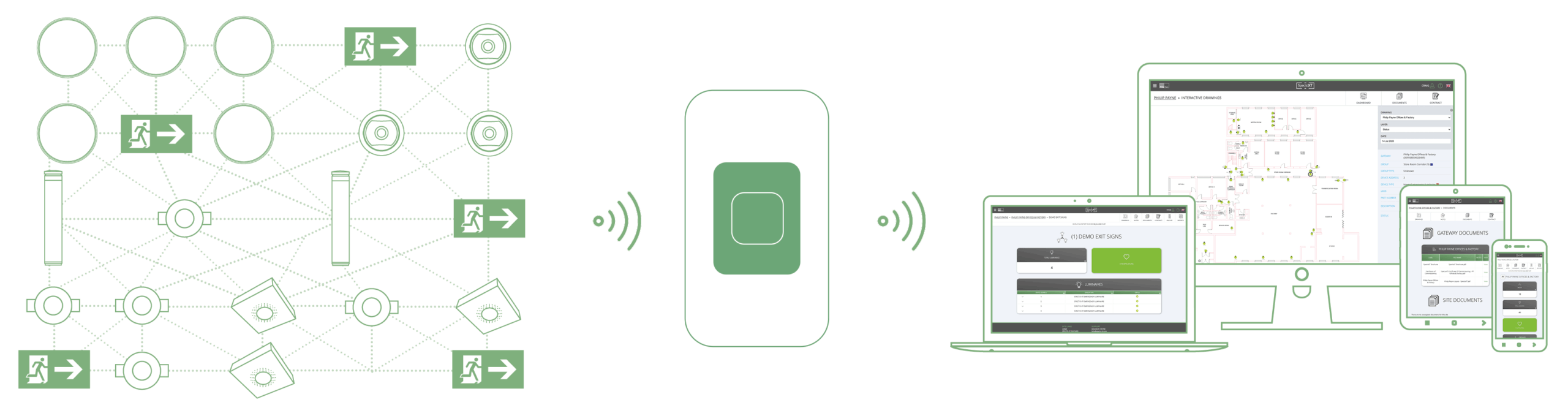
Compatible Specto-XT Emergency luminaires wirelessly communicate with each other and the Gateway through the mesh network.
The Gateway transmits emergency luminaire status to the Specto-XT web server
Users employ their chosen device to access status reports.

Defines devices within the same system, establishing the wireless mesh network's boundary to prevent communication with adjacent buildings.

Luminaires with the same building and group address operate together, allowing up to 250 zones within a single building.

Each luminaire can be assigned a unique address for individual identification within a group.
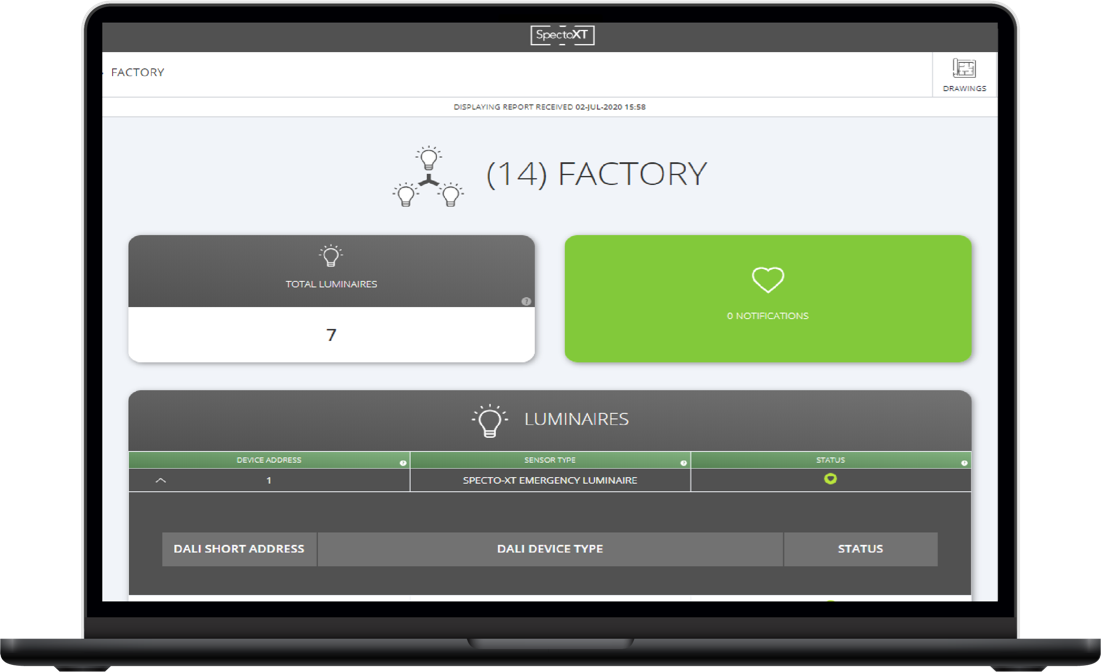
A full history of test reports is also available to view.
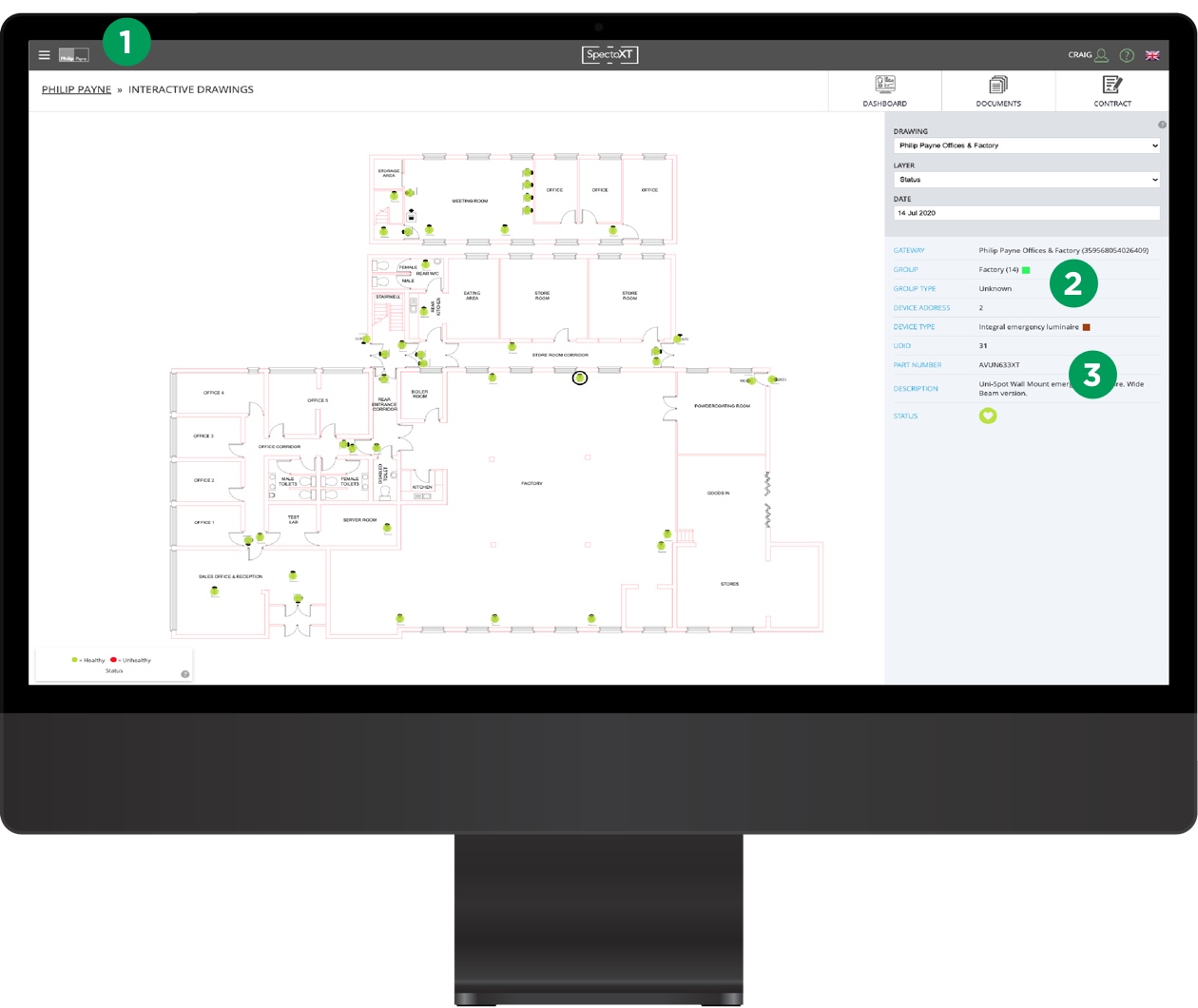
Philip Payne Interactive Drawings provide a simple and effective method of viewing system information.
Datasets are displayed as layers, allowing users to zoom in and out. Users can view data for the entire building or focus on a single room or luminaire.
Selecting a luminaire displays its data in an information table. Users can choose a date to view the status history of each luminaire.
Luminaires needing attention are highlighted in the Interactive Drawing. The Information Table shows the status of the luminaire's electronic components.
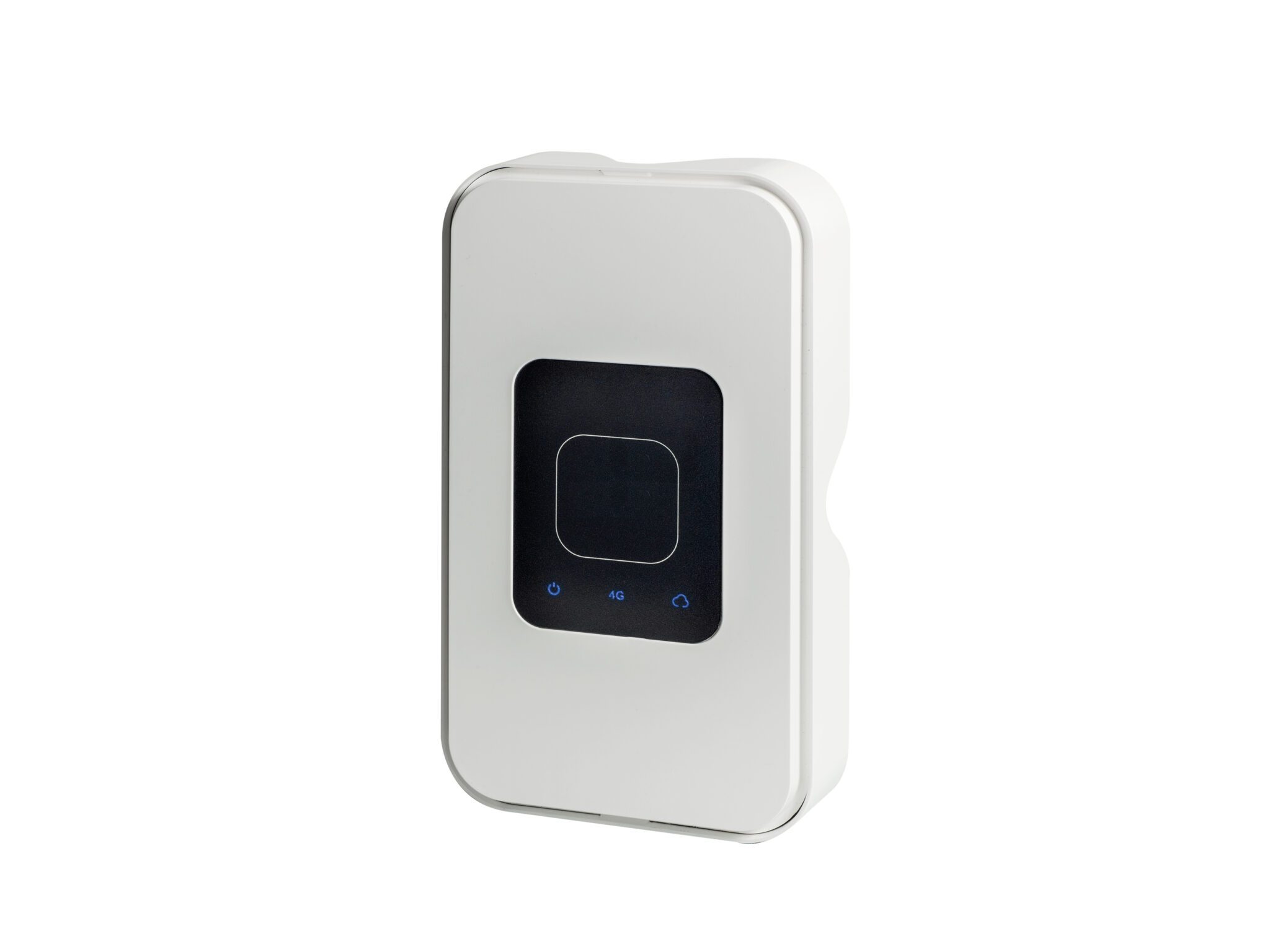
SPECTO-XT GATEWAY
Master control and web interface with Specto-XT wireless communication the Specto-XT gateway provides daily uploads of the system status to…
Learn moreBuilding owners, employers, or “responsible persons” are legally required to document the regular testing, inspection, and maintenance of their emergency lighting systems.
Relevant legislation, standards, and guidance documents include:
BS EN 50172:2024 outlines the following routine test schedule for self-contained emergency luminaires:
Conduct a full 3-hour test.
Energise each luminaire from its battery for a short duration to simulate mains failure. The lamp should illuminate using battery power.
Energise each luminaire from its battery for the full duration (typically three hours).
BS EN 62034:2012 is the European standard for automatic test systems for battery-powered emergency escape lighting. It requires devices to be self-monitoring and ensure that all tests are performed at specified intervals.
EN 55015: 2019 +A11:2020
Limits & methods of measurement of radio disturbances characteristics of electrical lighting & similar equipment
EN 61547:2023
Immunity
EN61000-4-3: 2020
Electromagnetic Compatibility (EMC) part 4-3. Testing and measurement techniques – Radiated, radio frequency, electromagnetic field immunity test
EN 300 220-2 v3.1.1
Short Range Devices (SRD) operating in the frequency range 25 MHz to 1000 MHz; Part 2: Harmonised Standard covering the essential requirements of article 3.2 of Directive 2014/53/EU for non specific radio equipment
EN 301 489-1 v1.9.2
Electromagnetic Compatibility (EMC) standard for radio equipment and services; Part 1: Common technical requirements
EN 301 489-3 v2.3.2
Assessment of electronic and electrical equipment related to human exposure restrictions for electromagnetic fields (0 Hz - 300 GHz)
Wireless transmission distance will vary depending upon the type of luminaire and its location.
Maximum achievable for an open area external site is approximately 70 metres from one Specto-XT transceiver directly to another, reducing significantly indoors particularly where transmissions may be affected by thick concrete walls or metallic structures.
Wireless mesh technology significantly improves transmission distances by propagating signals through many Specto-XT devices rather than simply point to point.
